“The time of the silent boys”
The Zone of Interest“The time of the silent boys” is the novel’s name for a massacre at Chełmno and for the wound that returns whenever its survivor tries to speak of it. On January 21, 1942, teenage Jewish boys were forced to help move bodies, then murdered in the snow. Their silence becomes more than a detail of the killing: it is an accusation against those who heard the violence, those who survived it, and those who later treat it as a curious exception.
Naming the Massacre
The phrase first appears as an informal name for the January Aktion at Kulmhof that led to the recruitment of Szmul into the Sonderkommando. The narrator observes that people regard the episode as a rare behavioral curiosity, perhaps a one-off. That apparent distance is part of the phrase’s force. Calling the event a time gives it the shape of a period that might be sealed off from ordinary life; the narrative instead makes it recur, unsettling the survivors’ attempts to resume ordinary conversation and the reader’s temptation to treat the massacre as an isolated aberration.
The phrase also brings together two different kinds of knowledge. It identifies a concrete historical event, but it arrives through a witness’s imperfect, burdened acts of recollection. Elsewhere, the prisoners debate whether they will bear witness, and agree to exhume Josef’s testimony, written in Yiddish in black ink on eight pages and hidden in a child’s galosh beneath the hedge bordering Paul Doll’s garden. The document is difficult to read aloud: the narrator begins to recount a girl of five, then stops, saying that the account seems mixed up. The phrase about the boys belongs to the same world of testimony, where preserving the fact of violence does not make it fully speakable.
January 21 at Chełmno
The account gives the date and circumstances with stark precision. From five in the morning until five in the evening, German power used whips. Three gassing vans repeatedly travelled from the Schlosslager to the Waldlager, unloading bodies before starting up again. The cold was deafening, but the scene was not silent: the wind, the whips, and the vans could all be heard. The recurring insistence on sound makes the boys’ silence more disturbing, not less. It is set against a place saturated with audible violence.
As the number of victims grew, the SS and Orpo selected another hundred Jews to help the existing prisoners drag bodies to a mass grave. The supplementary work unit consisted of teenage boys. They received no food or water and laboured for twelve hours under the lash, naked in snow and hardened mud. These details define the boys not as distant symbols but as children subjected, in succession, to forced labour, exposure, and deliberate deprivation.
At dusk, Major Lange led them to the pits and shot them one by one. When his ammunition ran out, he used his pistol butt to crush their skulls. The boys jostled to be next in line but made no sound. The sentence describing that silence follows a meticulous account of what could be heard; its force depends on the contrast. Their quiet is not consent or calm. It is the final, unbearable feature of a murder that the surrounding world registers through noise.
The Witness’s Loss
The massacre returns within a personal history of separation. The narrator says that Shulamith, his wife, remains in the attic above a bakery in Litzmannstadt, and that he loves her while being glad he will never see her again. He cannot imagine telling her about the selections, the disrobing room, Chełmno, or the time of the silent boys. The phrase thus marks a boundary in their relationship: the experience is not simply news he has yet to deliver, but knowledge that makes reunion and explanation seem impossible.
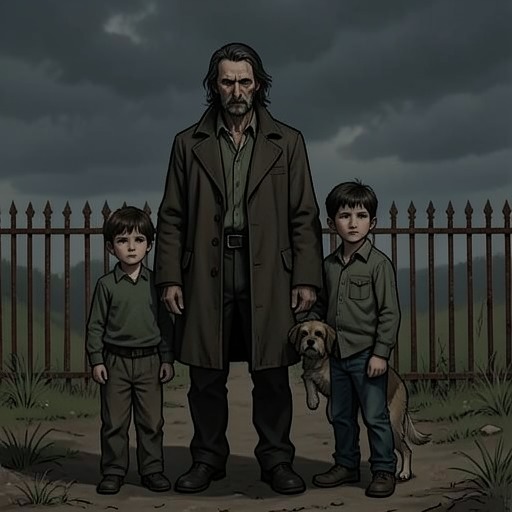
A later recollection places the boys within a family’s ordinary past. The witness remembers walking home from school with his sons, sharing chicken soup and brown bread, and embracing his wife that night amid public anxiety and a sense of solidarity. Six days later, the city was full of rotting horses. On his first transport, supposedly bound for Germany and expected to offer paid work, he took his sons with him: Chaim, fifteen, and Schol, sixteen. The terse confirmation that they were among the silent boys collapses the distance between the named victims of a public massacre and the children remembered at home. The phrase carries their absent voices into every later attempt to tell the story.
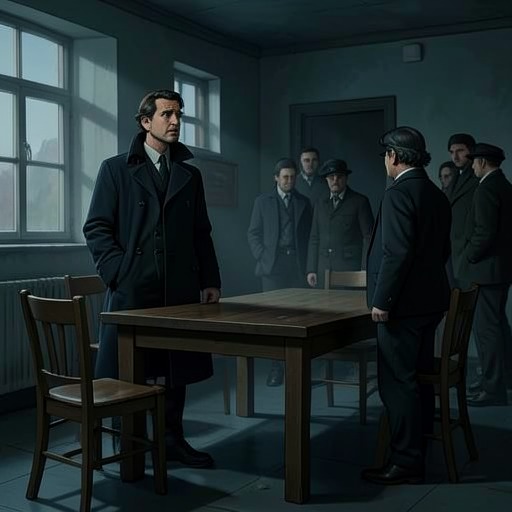
That personal knowledge also changes how the narrator understands his own survival. When the phrase returns, the recollection is not presented as an orderly report delivered after the danger has passed. It breaks into the present, beside an exchange in which Paul Doll threatens to make the Sonder perform a service before he leaves. The movement between the threat and the remembered killings makes the past active: the witness is still vulnerable to the power that demands further participation, while the earlier massacre has already become an experience he cannot set aside.
Recurrence, Policy, and Complicity
The phrase’s returns resist the claim that the massacre was an isolated oddity. In a later discussion, Angelus Thomsen hears an account of how Nazi policy moved from the prospect of expelling Jews to the killing of women and children. A letter drafted by Eichmann and Heydrich and signed by Goring is described as authorizing a total solution; the narrative also describes pressure among officials in Poland as deportations and annexations created problems of scale. Professor Entress argues that gas chambers and crematories were means of accelerating killing and sparing the killers’ nerves, not evidence that mass murder depended on a uniquely industrial method. Bullets and pyres, he says, would have achieved the same end. The narrative’s placement of the boys’ massacre beside this broader account makes the episode a concentrated instance of a larger policy, not an exception to it.
The institution’s conflicting demands make that process visible from another angle. Paul Doll thinks of the pressure to increase labour for the munitions industries and the competing pressure to dispose of evacuees. His language exposes the bureaucracy’s attempt to manage human beings as labour strength or a security problem, while his antisemitic claims dress persecution up as self-defence. The boys’ forced labour belongs to the same brutal logic: they are made useful for a task and then killed. Their murder reveals the lethal limit of any distinction between exploitation and extermination.
The phrase finally names a failure of ordinary language as well as a memory. At dawn, the prisoners can talk, use one another’s names, gesture, and raise their voices, yet the narrator feels that something intrinsic to human exchange is missing. The boys’ silence, the witness’s inability to tell Shulamith, and the halting reading of Josef’s hidden pages form a pattern: testimony is necessary, but it cannot restore what has been destroyed or make the experience whole. By returning to the phrase rather than resolving it, the novel preserves the massacre as an unresolved demand to remember.